
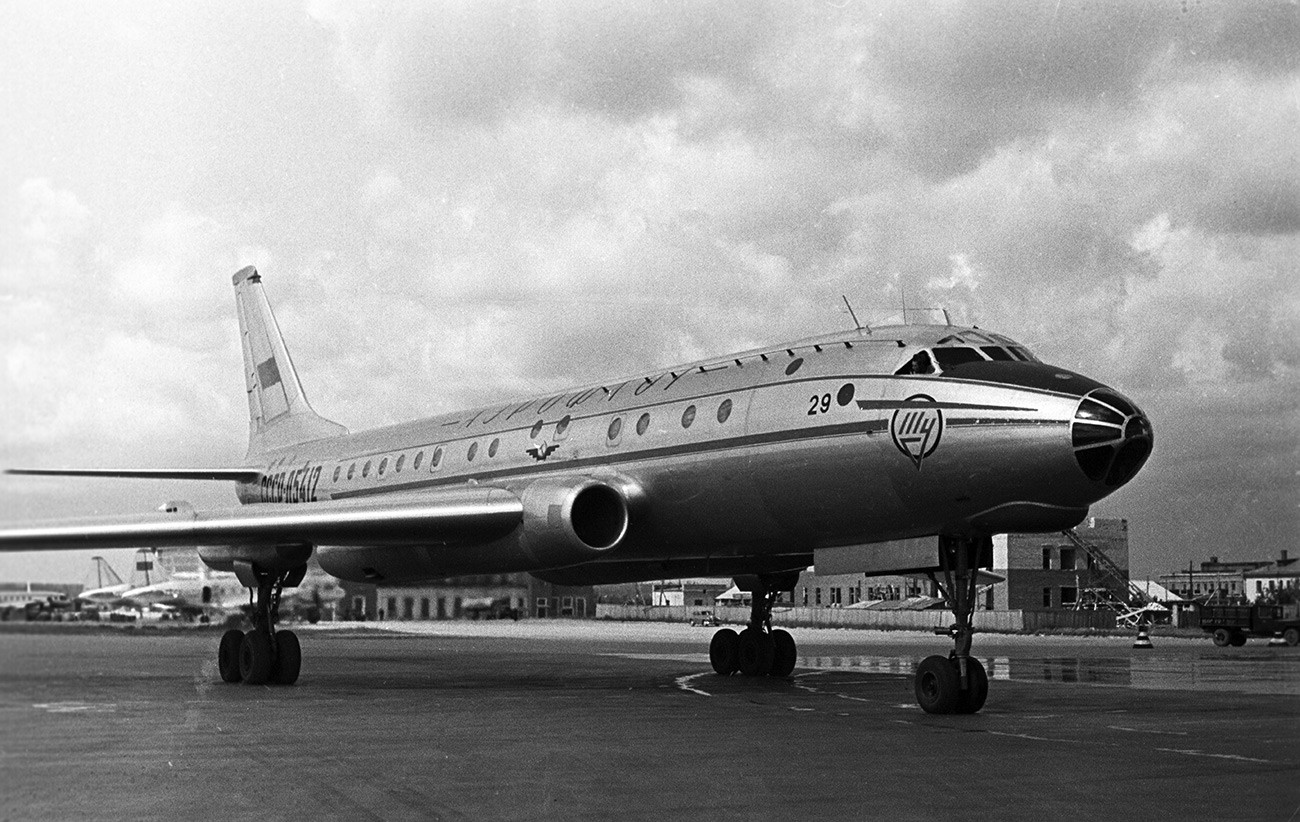
The Tupolev Tu-104: The Bomber-Made Airliner That Briefly Ruled the World's Skies
When the Tupolev Tu-104 lifted off from Moscow's Vnukovo Airport on September 15, 1956, it did more than launch a new route. It launched the Soviet Union into the jet age — and, for a brief two-year window, made it the only nation in the world flying passengers in a jet airliner.
The twin-engine Tu-104, NATO codename "Camel," was only the second jetliner in history to enter scheduled airline service, trailing the British de Havilland Comet. But while the Comet lay grounded after a series of deadly mid-air breakups, the Tu-104 was just getting started. From 1956 to 1958, it was the only jetliner operating anywhere on the planet — a source of enormous pride for the Kremlin, and a Cold War propaganda victory to match the Sputnik launch that would follow a year later.
Born From a Bomber
The Tu-104's story begins in the early 1950s, when the Soviet state airline Aeroflot — then the world's largest carrier — recognized that its fleet of propeller-driven Lisunov Li-2s and Ilyushin Il-12s was aging fast and struggling to cover the Soviet Union's vast distances. What the airline needed was a modern transport with far greater capacity, range, and speed.
The answer, as aviation historians consistently note, was not to design a new airplane from scratch, but to raid the weapons arsenal. Aeroflot asked the Tupolev Design Bureau whether it could build an airliner based on the Tu-16 "Badger," the Soviet Air Force's swept-wing strategic bomber. It was a radical shortcut: the Tu-104 kept the Tu-16's wings, engines, undercarriage, and tail surfaces almost unchanged, and wrapped them in a brand-new, wider, pressurized fuselage intended to carry about 50 passengers. Even the glazed bomber-style nose for the navigator was carried over.
Tupolev's chief designer, Andrei Tupolev, presented the concept to Soviet leader Joseph Stalin just weeks before the dictator's death in March 1953. Under Stalin's successor, Nikita Khrushchev — an aviation enthusiast who saw civil aviation as a pillar of his strategy to "catch and overtake" the West — the project was greenlit with the highest priority. On June 11, 1954, the Council of Ministers sanctioned the construction of the new airliner, designated Tu-104.
The pace of development was astonishing by modern standards. In just 14 months, Tupolev's Moscow design bureau, which by then employed around 10,000 people, produced a flying prototype. On June 17, 1955, the Tu-104 made its maiden flight from the Flight Test and Development base at Zhukovsky, with test pilot Yuri Alasheyev at the controls — a full two months ahead of schedule. The first production aircraft followed in November 1955. To handle the runways of the time — only a handful of Soviet airports could accommodate the new jet's demanding takeoff requirements — the airliner was fitted with a drag parachute that could shorten the landing roll by up to 400 meters (1,300 feet).
A Global Debut
The Kremlin wasted no time using its new aircraft for international showmanship. On March 22, 1956, a Tu-104 prototype touched down at London's Heathrow Airport carrying General Ivan Serov, head of the KGB, ahead of an official visit by Khrushchev and Nikolai Bulganin. According to a Russian television documentary, Khrushchev himself wanted to pilot the little-tested jetliner into Heathrow and had to be talked out of it by Tupolev, who raced to the impetuous leader's dacha to stop him.
The aircraft entered regular Aeroflot passenger service on September 15, 1956, on the Moscow–Omsk–Irkutsk route, replacing the propeller-driven Ilyushin Il-14. The results were dramatic: the flight time from Moscow to Irkutsk fell from roughly 13–17 hours to just over seven, and on some routes the journey was slashed to around five and a half hours. The pressurized cabin, air conditioning, and noise-damping measures made it one of the quietest, most comfortable airliners of its era.
By 1957, Aeroflot had deployed the Tu-104 on international services from Vnukovo Airport to London, Budapest, Copenhagen, Beijing, Brussels, Delhi, Ottawa, and Prague. In September 1957, a Tu-104A became the first Soviet civil aircraft to visit the United States since World War II, carrying officials to a UN session in New York. And in 1957, Czechoslovak Airlines (ČSA) — the type's only export customer — bought six examples and became the first airline in the world to operate a route served exclusively by jet airliners, between Prague and Moscow.
Specifications and Variants
The Tu-104 was a technical tour de force for its time. Powered by a pair of Mikulin AM-3 turbojet engines — the same family that equipped the Myasishchev M-4 bomber — it could reach a top speed of around 590 mph (950 km/h), with a cruising speed of 470–530 mph at altitudes between 32,800 and 39,400 feet. It was, on its introduction, the fastest airliner in the world. Range, however, was a weak point: at roughly 1,320–1,900 miles depending on payload, most flights across the Soviet Union required multiple stops.
Production ran from 1956 to 1960, with around 200 aircraft built across several variants. The Tu-104A, introduced in 1957, used more powerful Mikulin AM-3M engines and carried 70 passengers. The Tu-104B, which entered service on April 15, 1959 on the Moscow–Leningrad route, stretched the fuselage by 1.2 meters and accommodated up to 100 passengers, and was briefly the world's fastest airliner. Later conversions included the Tu-104D and Tu-104V. A four-engine development, the Tu-110, was built but never entered service, and a militarized transport version, the Tu-107, remained a one-off.
A Troubled Safety Record
For all its speed and prestige, the Tu-104 earned a fearsome reputation. It was heavy on the controls, fast on approach, and — like many highly swept-wing aircraft of its generation — prone to stalling at low speeds with little or no warning.
The dangers became clear in 1958. On August 15, Aeroflot Flight 04, a Tu-104A, stalled and spun into the ground in the Khabarovsk region after entering an updraft at 39,000 feet, killing all 64 people on board — the type's first fatal accident. Two months later, on October 17, another Tu-104A pitched up violently, entered an irrecoverable dive, and crashed near the town of Kanash, killing all 80 people on board, including high-ranking diplomats from several Soviet-aligned countries traveling to Moscow for an official event.
Soviet investigators identified a dangerous phenomenon: the aircraft's tendency to "grab" — a violent nose-up pitch at high altitude that preceded a stall and an unstoppable dive. In the wake of the Kanash disaster, the Kremlin — which famously had no public outcry to fear — kept the Tu-104 flying, but restricted its service ceiling to around 30,000 feet and redesigned the stabilizers. Tupolev himself was initially defiant, reportedly fuming: "There is nothing wrong with the plane. It is you who do not know how to fly it." But pressed by the Soviet Council of Ministers, he approved changes to the wing design and flight controls that resolved many — though not all — of the problems.
Pilots grew wary. Fearing inadvertent stalls, aircrews routinely landed the aircraft at 270–300 km/h, roughly 50 km/h faster than the recommended approach speed. The type continued to suffer from a poor safety record compared with Western jetliners: the American Flight Safety Foundation estimated that between 1958 and 1981, 16 Tu-104s were lost in crashes, with at least 1,140 fatalities, out of some 37 aircraft written off. Accidents had many causes — engine failures, faulty instrument readings from water-damaged wiring, overloaded takeoffs, even a freak incident in June 1962 when an errant anti-aircraft missile fired during an air-defense exercise brought down a Tu-104, killing all 84 on board.
The End of the Road
By the early 1960s, the arrival of the Boeing 707 and Douglas DC-8, with their far greater range, had eclipsed the Tu-104 on the world stage, and the Soviet Union never really caught up in long-haul jet travel. At home, the Tu-104 soldiered on, carrying over 90 million passengers for Aeroflot across more than two decades of service.
Aeroflot finally retired the type from civilian service in March 1979, following a fatal crash at Moscow-Vnukovo. The Soviet military, however, continued to use retired airframes as VIP and staff transports — and, notably, as zero-gravity training aircraft for cosmonauts performing "zoom" maneuvers.
The type's final act was tragic. On February 7, 1981, a Soviet Navy Tu-104A crashed shortly after takeoff from Pushkin Air Base near Leningrad (now St. Petersburg), killing all 50 people on board — including 16 admirals and generals, among them the commander of the Soviet Pacific Fleet, Admiral Emil Spiridonov. Investigators concluded the aircraft was improperly loaded, with heavy paper rolls shifting rearward during the takeoff roll and pushing the center of gravity beyond safe limits. The catastrophe ended the Tu-104's military career; the remaining fleet was permanently grounded.
The last Tu-104 ever to fly made a final ferry flight to the Ulyanovsk Aircraft Museum on November 11, 1986. Its legacy, though, endures. The experience Tupolev gained with the airliner led directly to its successors — the Tu-124, the world's first series-built turbofan airliner, the Tu-134, and the hugely successful Tu-154 — ensuring that the old bomber-based jet's DNA lived on in Soviet civil aviation for generations. A flawed pioneer, remembered as often for its disasters as for its triumphs, the Tu-104 nevertheless holds an unshakable place in history: the aircraft that put the Soviet Union in the jet age, and for one shining moment, ahead of the world.